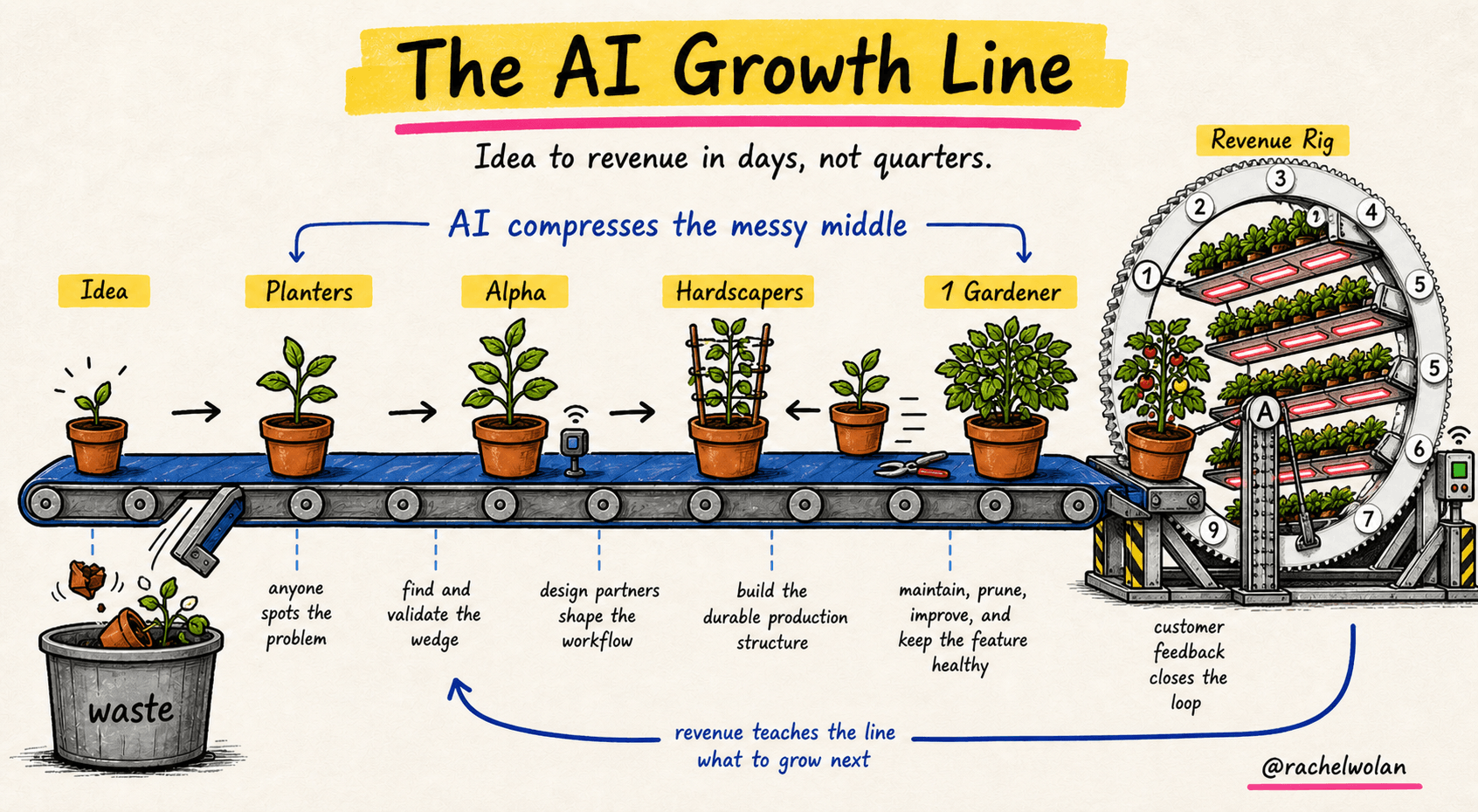
How AI-native teams plant, scaffold, and tend products from idea to revenue.
TLDR
A feature should not carry a standing org chart forever. Two Planters validate whether the wedge is worth planting. A Hardscaping Crew hardens the alpha into production. One Gardener keeps it alive, ships most enhancements directly, and sends only the hard 20% back to engineering. The metric is days from idea to revenue.
01The Old Org Chart, the New One
A single new feature used to require 5-8 engineers, plus the meetings that come with them. Six standing meetings a week. A status doc nobody reads. Six months minimum.
The better analogy is not an old garden with rows of soil and hand tools. It is vertical farming: indoors, instrumented, stacked into far less ground space, and tended by machines. Dyson's strawberry glasshouse uses rotating vertical rigs, LED support, climate control, and robots that pick ripe fruit, shine UV light at night, and distribute insect predators to protect the crop. That is why this is a garden, not a factory. The point is not just output. The point is creating the conditions where a product can take root, keep growing, and produce revenue. Dyson's vertical farming article is the physical-world version of the model.
I think the same feature now takes three focused crews and a pack of agents. 2 Planters validate the wedge. A Hardscaping Crew scales what the planters proved. 1 Gardener maintains and enhances it for the rest of its life, the agents run ops, the Gardener ships 80% of enhancements alone. AI absorbs everything between.
That is the unit of an AI-native product org. Not a roadmap. Not a headcount plan. A growth system.
02The Growth Line
The whole lifecycle, on one page.
03The Three Crews
Three crews. Three jobs. Same feature, moving from validated to scaled to maintained. The headcount actually shrinks as the feature matures. That is the AI-native shape.
Crew 01 · Validate
2 Planters
2 Domain Experts + Agents.
Whoever's closest to the problem. Owns the wedge, the customer evidence, the kill criteria. Runs interviews. Drafts the thesis. Ships a 30-day MVP with pre-committed design partners.
Output: an alpha 5–20 partners actually use.
Tools: Claude Code, Cursor, prep doc per call, thesis with explicit kill criteria.
Crew 02 · Scale
Hardscaping Crew
3–4 engineers + Agents.
Takes the alpha and hardens it for production. Integration, infra, observability, security review, rollout plan.
Output: a production-ready feature with metrics instrumentation wired up.
Tools: Agentic coding, AGENTS.md committed, CI with eval gates, on-call from day one.
Crew 03 · Maintain & Enhance
1 Gardener
1 Builder.
Often a Planter staying on. Agents watch usage, catch regressions, draft the health report, file routine PRs.
The Gardener ships 80% of enhancements directly with Cursor or Claude Code. The hard 20% routes back to engineering.
Tools: Observability with eval gates, agents with scoped write access, published runbook, Gardener with repo access.
Note the shape: validation needs taste. Scale needs craft. Maintenance needs coverage, and coverage is what AI is best at. The old org chart kept all three crews staffed for the life of the feature. The new one collapses the back half.
One more thing: a garden is not an open floor plan. Not every bed is meant to be touched by everyone. Some areas are fragile ecosystems: old customer contracts, regulated workflows, brittle integrations, trust surfaces, pricing logic, data migrations. You work around those with paths, fences, sensors, and clear stewardship. Other areas are hardy plants in high-traffic soil: docs, workflows, internal tools, copy, onboarding, reports. Those can tolerate more hands, more agents, and more frequent pruning. The operating model is knowing which is which before you hand out write access.
04The CPO Job at Each Waypoint
Six waypoints. Six jobs. None of them are "review the deck."
Idea. Green-light or kill. Set the kill criteria up front. No kill criteria, no green light. Otherwise it turns into a roadmap item nobody can close.
2 Planters. Protect the wedge. The planters will be pulled into status meetings, OKR rituals, and roadmap reviews if you let them. Don't.
Alpha. Enforce the merge gate. Alpha means 5–20 design partners actively using it. Not two demo viewers nodding politely. Not one champion at one logo.
Hardscaping Crew. Hold the team to scale, not build. The build was the alpha. The work now is integration, hardening, observability, and the rollout plan. Resist re-litigating the alpha decisions.
1 Gardener. Stand up the agents before the engineers leave. The agents inherit the eval suite, runbook, and customer-language glossary. The Gardener (one of the original Planters, ideally) stays on as the human partner who ships 80% of enhancements directly. Engineering returns only for the hard 20%.
Revenue. Measure cycle time. Days from idea (greenlit) to revenue is the accountability metric the whole line is judged by. Publish it. Track it. Hold yourself to it.
05What AI Absorbs
"AI absorbs everything between" is the load-bearing claim. Here is what that actually means.
Coordination work
Status updates
Standing-meeting prep
Cross-functional translation docs
OKR rollups
Research and synthesis
Call-note summarization
Cross-call divergence tables
Competitive teardowns
First-draft PRDs
Production overhead
Boilerplate code
Schema migrations
Test scaffolding
Documentation
Communication output
Slack drafts
Customer follow-ups
Release notes
Internal announcements
That is the old 5-8 engineer org chart. Each handoff existed because each workstream was a human-shaped job. They are not human-shaped jobs anymore.
06What Humans Keep
The point is not to remove people from the work. It is to stop asking people to carry every handoff, status update, and first draft. The human work gets smaller, but it matters more.
Spotting the pain worth planting. Someone has to notice when a customer is working around the product, not just using it. Someone has to ask, "Is this a weird edge case, or is this the start of something real?" That is the Planter job.
Making it sturdy enough to trust. A demo can be messy. A production feature cannot be. Someone still has to decide what needs a real integration, what needs observability, what could wake up the on-call person, and what will make the next build easier instead of harder. That is the Hardscaping Crew job.
Keeping it alive after launch. Launch is not the finish line. A real customer will find the confusing label, the missing export, the odd permission case, and the small improvement that makes the feature stick. The Gardener stays close enough to hear that signal and ship the changes that keep the feature healthy.
That is the shift: fewer people babysitting the process, more people making the calls that actually shape the product.
07The Punchline
Gardener CPOs make them take root and harvest them.
A feature is not done when it launches. It is done when a customer uses it, gets value from it, pays for it, and keeps coming back. That is the number the whole system should care about: days from idea to revenue.
Two Planters find the wedge. A Hardscaping Crew makes it sturdy. One Gardener keeps it healthy. Agents do the busywork around the edges. The CPO's job is to protect that line, measure it, and keep asking the only question that matters: is this thing growing?
The old org chart asked, "Who owns the feature?" The new one asks, "Who is making sure it lives?"